
.jpg)
Consumer confidence just fell to 50.3 — one of the lowest readings in recent history, fueled by the ongoing federal shutdown, rising inflation concerns, and worsening economic sentiment.
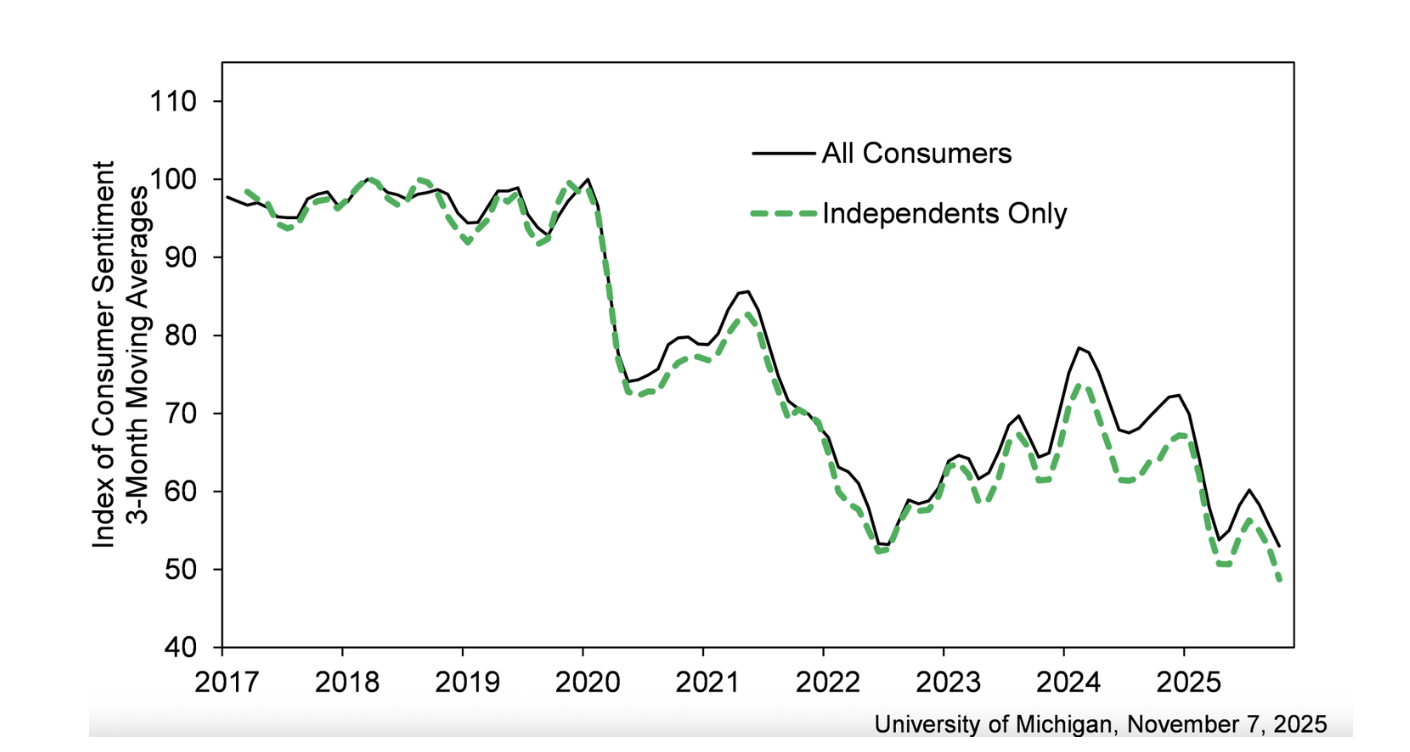
Shoppers are shifting fast:
Most companies treat this as a signal to panic, pause spending, and wait for the sky to clear.
But fearless leaders know better.
Uncertainty doesn’t weaken strong brands, it exposes weak ones. It’s the ultimate stress test for your identity, your strategy, and your leadership. While competitors freeze, you have a rare opportunity to move with intention, deepen trust, and capture share.
Here’s the paradox shaping the market right now:
This isn’t predictable behavior. It’s emotional behavior.
And brands that understand those emotional drivers win.
When the market panics, great leaders don’t shrink. They focus. Here are the three strategic plays that separate brands that survive from those that surge ahead.
Lead with clarity while others go quiet.
In turbulent times, your brand is your competitive moat. When uncertainty rises, consumers default to the brand they know, trust, and recognize instantly.
Most companies cut budgets. Fearless leaders double down on identity, consistency, and presence.
Confusion is the #1 killer of brand trust. Clarity wins.
1. Audit every touchpoint. One brand, one voice, zero confusion.
2. Protect brand-building budget. Your spend goes farther when competitors retreat.
3. Tell consistent stories. When buyers are uncertain, they choose the brand that feels stable.
4. Enforce your guidelines. Templates and guardrails eliminate inconsistency at the source.
You don’t just defend your position — you expand it. When the economy rebounds, you’re not playing catch-up. You’re already in front.
Your humanity is your strategy.
In times of stress, customers don’t buy products.
They buy trust.
They buy reassurance.
They buy brands that feel like allies.
Empathy isn’t soft — it’s strategic.
Among consumers:
Experience now drives 60% of buying decisions.
Nike (COVID-19):
Made premium training content free, supported the world emotionally, and strengthened affinity while stores were closed.
Major Insurer (2024–25):
Empathy-driven CX increased TNPS 7 points in 18 months.
1. Shift messaging to “how we help,” not what we sell.
2. Be transparent about costs, decisions, and efforts to support customers.
3. Build campaigns that say: We see you. We’re with you.
4. Personalize thoughtfully: fewer, more meaningful messages.
5. Tie every touchpoint to an emotional outcome (confidence, relief, joy).
Empathy builds bonds that beat price wars, outlast economic cycles, and create loyalty money can’t buy.
Innovation loves a tight budget.
Constraints are the birthplace of originality. When you can’t outspend competitors, you outthink them.
Mailchimp (2008):
Pivoted to freemium → explosive growth.
BMW (2001):
Created The Hire film series → massive buzz + 12% sales increase.
Lego (2008):
Expanded globally → all-time-high profitability.
1. Push teams to find low-cost, high-impact wins.
2. Celebrate resourcefulness, make it cultural.
3. Explore business model innovation.
4. Expand into underserved markets.
5. Invest in people, not layoffs. Your team is your edge.
Constraints don’t limit you, they free you from convention. These innovations become long-term competitive advantages.
When the 2008 Great Recession hit, most companies slashed marketing budgets and hunkered down. Procter & Gamble did the opposite—they increased their advertising investment and doubled down on brand-building when competitors went silent.
The Context: During the 2009 recession, P&G understood that downturns present opportunities to gain market share from weaker competitors who reduce their advertising spend. While others cut costs across the board, P&G saw the chance to own more consumer mindshare.
The Play: By increasing ad spend, P&G gained a larger share of voice in the marketplace. They maintained consistent brand presence across all their household name products: Tide, Pampers, Gillette, Crest, reinforcing the trust and recognition they'd built over decades. They didn't just maintain visibility; they invested in emerging markets like Brazil and India, launching innovative product lines like "basico" (basic) products in Brazil that maintained brand equity while addressing price sensitivity.
The Strategy Behind It: P&G recognized that strong brands with high equity can charge premium prices and maintain customer loyalty even when wallets tighten. Rather than competing on price alone, they focused on the emotional connection and trust consumers had with their brands. They knew that Tide wasn't just detergent, it was reliability. Pampers wasn't just diapers, it was peace of mind.
The Result: P&G won a larger market share and emerged from the recession in a position of dominance. When COVID-19 hit in 2020, P&G deployed the same playbook: The company maintained and increased marketing spend during COVID, leading to surging revenues in 2020. Their cleaning products saw explosive demand, but it was their brand equity—built through decades of consistent investment—that allowed them to capitalize fully on the moment.
The Lesson: P&G's success across two major recessions proves that brand equity isn't just a nice-to-have—it's a strategic weapon. When you've built trust, recognition, and emotional connection with consumers, you don't compete primarily on price. You compete on the strength of your brand, and that strength only grows when competitors retreat from the battlefield.
Identify one “business-as-usual” expense that’s underperforming.
Reallocate that exact amount to a move that deepens customer connection.
A bold leader isn’t the one with the biggest budget — it’s the one who knows where to place the next bet.
Ready to build the strategy that makes competitors freeze when your name comes up?
📅 Book 30 Minutes with Me here.
Let’s design your downturn advantage.
Be Bold.
Be Strategic.
Be Fearless.
Until next time,
Anna Bruno Bleers

